
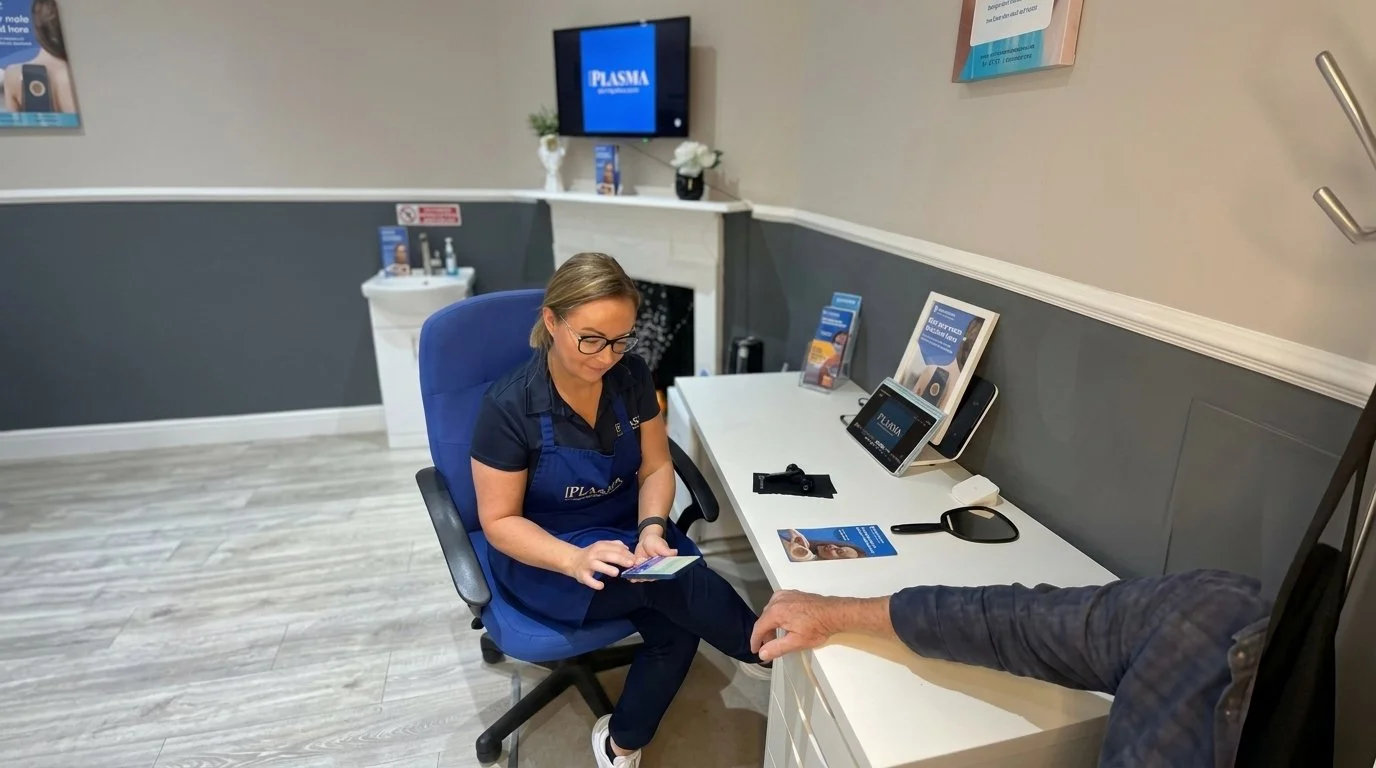
Plasma Pen Fibroblast Skin Tightening
An evidence-based clinical breakdown of Plasma Pen Fibroblast therapy at Plasma NI. Learn the biophysics of plasma arc contraction, collagen stimulation, safety protocols, and realistic recovery expectations.
Clinical Fact: While tissue contracted during the procedure is permanently tightened, your skin continues its natural biological aging process. Environmental factors, UV exposure, and intrinsic collagen depletion will cause natural laxity over time. Results typically endure 2 to 3 years before maintenance is requested.
Clinical Fact: Plasma Pen non-surgical blepharoplasty is highly effective for mild-to-moderate upper eyelid skin hooding and fine laxity. However, for severe skin excess, structural herniated fat pads, or severe ptosis, surgical intervention remains necessary.
Clinical Fact: True. The micro-plasma arc sublimes superficial epidermal tissue instantly, causing visible immediate contraction. However, the true long-term tightening develops over 8 to 12 weeks as dermal fibroblasts synthesize new Type I and Type III collagen fibers.
Clinical Fact: FALSE. Due to the mechanism of controlled thermal epidermal trauma, Plasma Pen carries a high risk of Post-Inflammatory Hyperpigmentation (PIH) or hypopigmentation in darker skin tones. It is strictly indicated for Fitzpatrick Skin Types I–III.
Clinical Fact: False. Micro-carbon crusts (tiny dark dots) remain on the treated zone for 5 to 10 days. Periorbital swelling (around the eyes) peaks at 24–48 hours post-treatment. Clients require a clear aftercare window without makeup or direct sun exposure.
Skin Profile: Very fair to medium olive skin (always burns/freckles to burns moderately then tans slowly).
Clinical Insight: Melanin activity is low enough that controlled plasma arc thermal injury carries minimal risk of abnormal pigmentary side effects when post-treatment sun protection protocols are maintained.
Skin Profile: Light brown to olive skin (rarely burns, tans easily - e.g., Mediterranean / Hispanic / Asian sub-types).
Clinical Insight: Elevated melanocyte activity increases the risk of Post-Inflammatory Hyperpigmentation (PIH). Requires mandatory clinical spot patch testing and pre-treatment tyrosinase inhibitor conditioning.
Skin Profile: Dark brown to deeply pigmented skin (Types V & VI).
Clinical Insight: Plasma Pen thermal arc energy will disturb melanocyte density, leading to irreversible hypopigmentation (white spots) or severe hyperpigmentation. Alternative non-thermal tightening modalities are advised.
Plasma is the fourth state of matter (gas ionized by high voltage). The Plasma Pen device holds a micro-probe millimeters above the skin surface, creating a precise electrical discharge arc between the probe tip and the moisture in the air.
Plasma Pen therapy is tailored for localized zones requiring precision skin contraction that are difficult to treat with laser or microneedling alone.
| Treatment Zone | Primary Clinical Target | Typical Sessions Needed |
|---|---|---|
| Upper Eyelids (Non-Surgical Blepharoplasty) | Hooded, lax eyelid skin excess | 1 – 2 Sessions |
| Lower Periorbital (Under Eye) | Crepey under-eye skin & fine wrinkles | 1 – 2 Sessions |
| Perioral Lines (Smoker's Lines) | Vertical lip wrinkles around mouth border | 1 – 2 Sessions |
| Nasolabial & Marionette Lines | Folds caused by dermal elasticity loss | 2 Sessions |
| Neck & Submental Area | Horizontal ring lines & mild turkey neck laxity | 2 – 3 Sessions |
Adherence to post-treatment medical aftercare is vital to achieve ideal skin smoothing and prevent unwanted scarring or hyperpigmentation.
Post-Treatment Recovery Stages:
- Days 1 – 3 (Inflammatory Phase): Local swelling (especially around eyes) and erythema (redness). Tiny dark carbon crusts (dots) form immediately.
- Days 4 – 7 (Shedding Phase): Swelling subsides completely. Carbon crusts dry and naturally flake off. Do NOT pick or scratch crusts.
- Weeks 2 – 6 (Erythema & Healing): Fresh, pink new skin is revealed beneath. SPF 50+ must be worn daily to protect against UV damage.
- Weeks 8 – 12 (Final Maturation): Full collagen matrix contraction is realized, displaying final skin tightening.
Safety is our absolute priority at Plasma NI. We do not perform Plasma Pen Fibroblast treatment under the following medical conditions:
Absolute & Relative Contraindications:
- Fitzpatrick Skin Types IV, V, or VI (High risk of hyper/hypopigmentation)
- Pregnancy or Breastfeeding
- Pacemaker or Implanted Electrical Devices
- Active Skin Infections, Herpes Simplex (Cold Sores), or Psoriasis/Eczema in treatment zone
- History of Keloid or Hypertrophic Scarring
- Use of Oral Isotretinoin (Accutane) within the past 12 months
- Uncontrolled Diabetes or Autoimmune Collagen Vascular Disorders